 NEXT ENERGY
On-grid or hybrid solar for your home in Thailand?
If most of your air conditioning or other heavy loads run during daylight, start with on-grid solar. If demand rises after sunset, or selected circuits need backup, compare a hybrid system with a battery. How much surplus solar can you store on a typical day?
When is a battery worth considering?
Starting prices include VAT. Your final quote depends on the work required at the site. Compare package prices and equipment · PEA guide to system types (Thai)
What size solar system fits a THB 5,000 monthly bill?
With 60% daytime and 40% nighttime use, NEXT ENERGY’s calculator estimates a 4.55 kWp on-grid array. Switching to hybrid and targeting all nighttime consumption increases the estimate to 9.10 kWp because the array also needs to charge the battery.
| Estimate | On-grid | Hybrid |
|---|---|---|
| 650 W panels | 7 panels | 14 panels |
| Array capacity | 4.55 kWp | 9.10 kWp |
| Estimated inverter size | 5 kW | 8 kW |
| Nominal battery capacity | None | 18 kWh |
Assumptions behind these figures
At an illustrative THB 4.50 per kWh over 30 days, the bill represents about 37.0 kWh per day. Of that, 22.2 kWh falls in daylight and 14.8 kWh at night. Both options target 80% of daytime use, or 17.8 kWh per day. At an assumed yield of 4 kWh per kWp per day, the on-grid option rounds up to seven 650 W panels.
The hybrid option targets 100% of nighttime energy, assumes 90% round-trip efficiency, 90% depth of discharge and 95% discharge efficiency, and rounds nominal battery capacity up to 18 kWh. Actual generation depends on sunshine, shading and roof orientation. The final inverter size also depends on simultaneous loads, the electrical supply and the equipment selected.
For a closer estimate, enter metered kWh and billing days from your bill. Then adjust the daytime share in the solar sizing calculator.
Three units to check on a solar quotation
- kWp · solar array capacity.
- Add up the power ratings of the panels. Ten 585 W panels give 5.85 kWp under standard test conditions.
- kW · power.
- Compare the inverter’s output with the power needed by appliances running at the same time. If backup matters, check the backup output rating for the proposed model.
- kWh · energy.
- This unit measures consumption on your bill and energy stored in a battery. Backup runtime depends on usable stored energy and the combined power draw of the circuits in use.
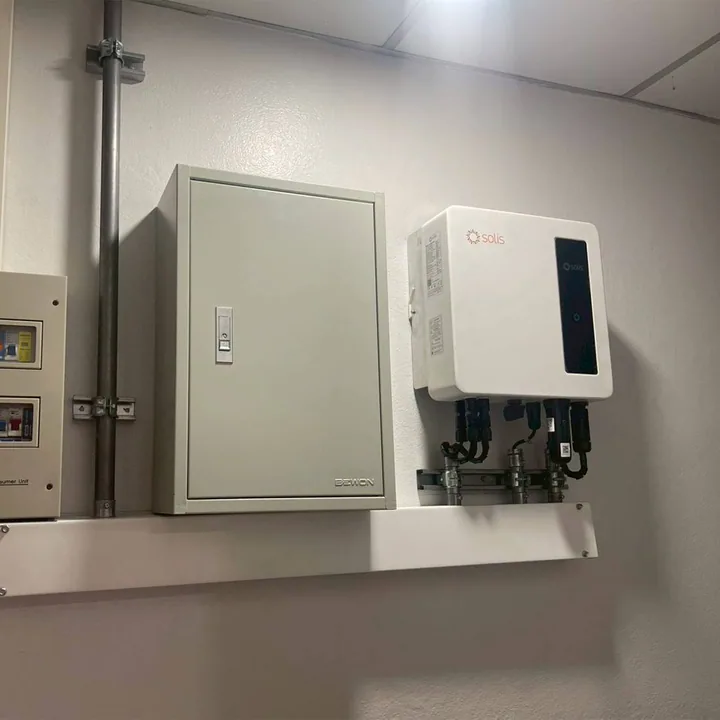
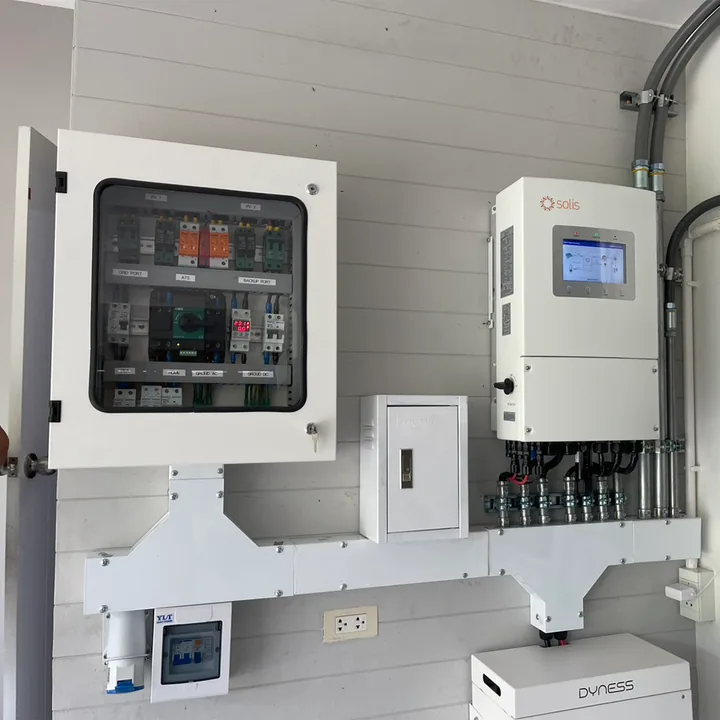
Two systems installed by NEXT ENERGY
What should you send for an installation quote?
- One to three electricity bills with metered kWh and billing days. If your meter app shows hourly use, include the chart so the installer can separate daytime and nighttime demand.
- Photos of the roof and main distribution board, the site location, and whether the supply is single-phase or three-phase if known.
- A list of appliances used at the same time. If you need backup power, identify which appliances must stay on and for how many hours.